
Built After 40 Why I’ve Never Been Out of Shape And It Has Nothing to Do With Genetics
The system approach to staying fit through a demanding career, fatherhood, and everything in between
Let me tell you something that might sound a little contradictory at first.
I’m a 42-year-old dad of two who spent 18 years grinding in the corporate world. Long hours. Back to back meetings. Business travel. Laptops open at 10pm. Weekends that evaporated.
I know what it feels like to have your life fully consumed by a career. The pressure. The exhaustion. The constant sense that there’s never enough time.
And through all of it, every demanding season, every impossible quarter, every stretch where sleep was a luxury, I never once fell out of shape.
Not because I have elite genetics.
Not because fitness comes naturally to me.
Not because I had a personal chef or a private gym in my office.
I stayed in shape because I figured out something that most people in the fitness industry will never sell you.
It’s not about the meal plan.
It’s not about the on demand workout program.
It’s about the system.
That’s the thing nobody wants to hear, because systems aren’t sexy. They don’t sell. You can’t charge $97 for a system.
But systems are exactly what keep a busy dad lean, strong, and energized while everyone around him is slowly declining and calling it “just getting older.”
This article is my attempt to give you what actually works.
Not a 30 day challenge.
Not a transformation program.
A framework you can run for the rest of your life.
The Real Reason Most Men Fall Out of Shape After 40
It’s not age.
It’s not a slowing metabolism.
It’s not even a lack of time.
It’s the approach.
Most men over 40 are trying to solve a lifestyle problem with a product.
They buy a program.
They follow a meal plan for three weeks.
They sign up for a challenge in January.
And when life inevitably gets in the way, as it always does, the whole thing collapses. They’re back to square one, feeling like they failed.
I watched this happen to colleagues throughout my corporate career. Smart, driven, successful men who could run a $50M budget but couldn’t maintain a workout habit for more than a month.
The issue wasn’t discipline. They had plenty of that.
The issue was that they were treating fitness like a project with a start and end date, instead of an operating system that runs in the background of their life.
When I started thinking about fitness the same way I thought about building reliable processes at work, everything changed.
Systems that don’t depend on motivation.
Systems that don’t require perfect conditions.
Systems that keep running no matter what.
The stress of the job was still there.
The long hours were still there.
But my health stopped being something I had to chase and started being something that happened automatically.
What a System Actually Looks Like
A system is not complicated.
It’s a set of non-negotiable behaviors that are so integrated into your daily life they require almost no decision-making.
That last part is key.
Decision fatigue is real. After a day of making hundreds of micro-decisions at work, asking yourself to summon motivation and willpower to work out is a losing game.
A system removes the decision.
It makes healthy behavior the default.
And over time, defaults become identity.
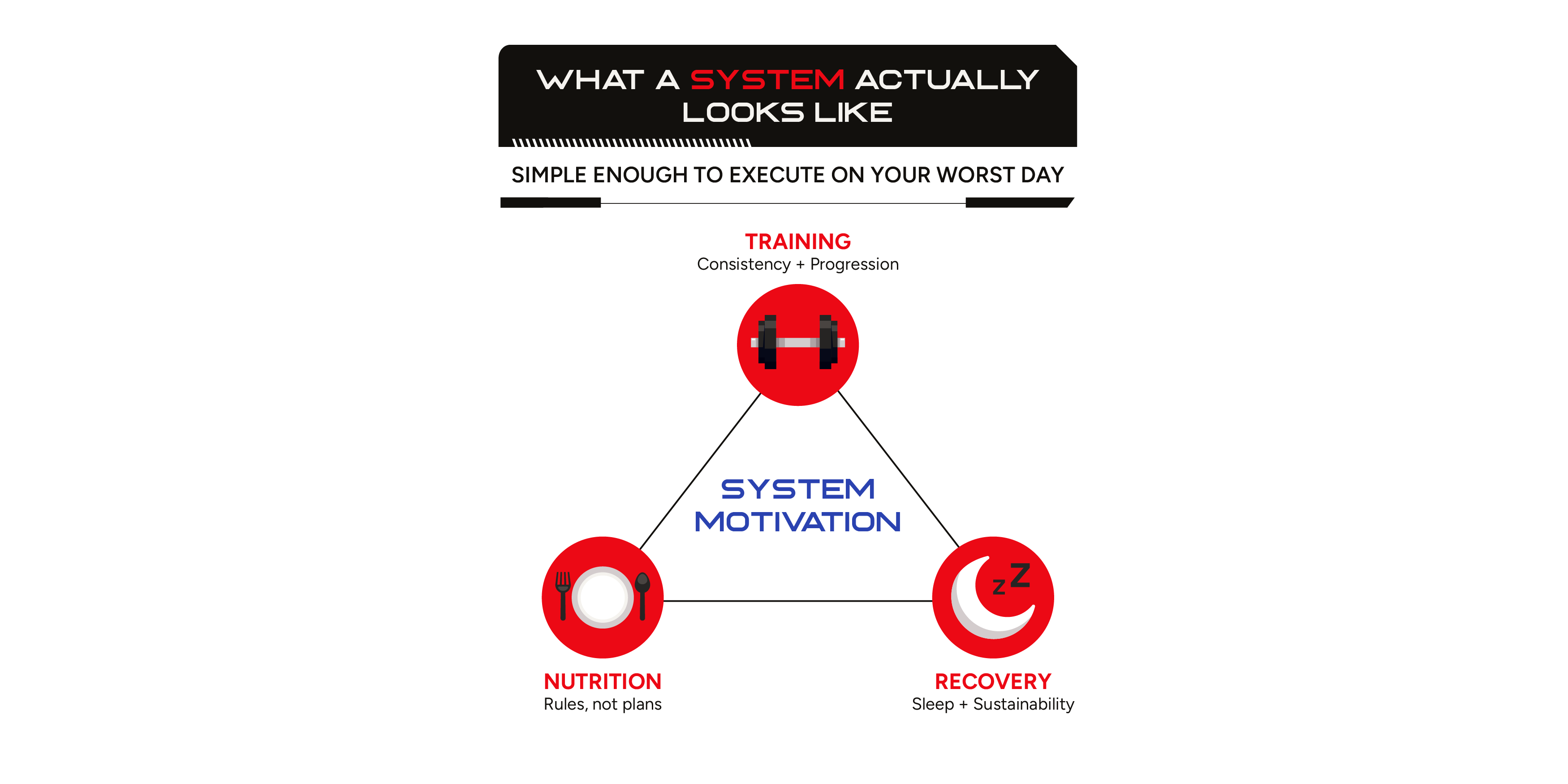
If your system only works when everything is going perfectly, it’s not a system.
It’s a hobby.
Pillar One: Training That Fits Your Real Life
The biggest training mistake men over 40 make is designing a program for the best version of their week instead of the average version.
Three hard sessions per week, consistently executed over two years, will produce results that six sessions per week attempted and abandoned never will.
My training system is built on four principles that haven’t changed in years.
Compound movements first
Squats, deadlifts, presses, rows, and pull-ups are the foundation. They recruit the most muscle and give you the highest return on every minute you spend in the gym.
Progressive overload, always
Your body only adapts when challenged. Track your workouts and make sure the numbers move over time. More weight, more reps, better form, or more intensity.
Without this, you’re exercising.
With it, you’re training.
Recovery is part of the program
After 40, recovery slows down. This isn’t a weakness, it’s physiology.
Three to four training days with full rest days in between is not undertraining. It’s how you stay in the game for decades instead of flaming out in months.
Show up on your worst days
A 30-minute session when you’re tired and stressed is worth infinitely more than the perfect 60-minute session you skipped.
The system doesn’t require energy.
It generates it.
Pillar Two: Nutrition Without the Obsession
Meal plans fail because life doesn’t follow a script.
Travel happens.
Celebrations happen.
Stressful weeks where you eat whatever’s in the fridge at 9pm happen.
A meal plan that requires perfect shopping, perfect prep, and perfect adherence isn’t a strategy.
It’s a pressure cooker.
My nutrition system is built on rules, not plans.
Rules are flexible enough to survive real life while still keeping you pointed in the right direction.
The most important rule: eat enough protein
Protein is the cornerstone of building and preserving muscle after 40.
It keeps you full.
Supports recovery.
Protects muscle during fat loss.
Has the highest thermic effect of any macronutrient.
Target 0.7 to 1 gram per pound of bodyweight per day.
At 190 pounds, that’s 130 to 190 grams.
Closing that gap alone will change your body composition significantly.
Beyond protein, the rules are simple:
- Eat mostly whole foods
- Stay hydrated
- Don’t restrict so aggressively that you feel deprived
- Anchor your day with a high-protein meal
Breakfast or lunch works well for most people.
And just as important, end your day with protein to reduce late-night snacking.
When the rest of the day gets chaotic, that anchor keeps you on track.
I’ve eaten at airports, hotel restaurants, fast food windows, and kids’ birthday parties for 18 years and never derailed my progress.
Not because I was perfect.
Because my rules traveled with me.
The meal plan stayed home. The rules came with me everywhere.
Pillar Three: Recovery as a Non-Negotiable
In the corporate world, rest is often treated as weakness.
The culture glorifies the guy who sleeps five hours and grinds harder.
I bought into that for years.
All it cost me was quality of life, sharpness, and physical health.
Sleep deprivation is not a badge of honor.
It’s slow self-destruction.
Here’s what changed my perspective.
Muscle is not built in the gym.
It’s built during recovery.
The gym provides the stimulus.
Recovery provides the result.
Cut short recovery and you cut short progress, no matter how hard you train.
The recovery pillar of my system has three components:
Consistent sleep
7 to 8 hours. Same bedtime as often as possible.
Daily movement
8,000 to 10,000 steps. Low-intensity movement that supports fat loss and recovery without beating up your body.
Stress management
Not just apps and breathing exercises.
For me, training itself is the stress management.
It’s the one part of the day that’s entirely mine.
That psychological anchor matters more than most people realize.
Build Your System: Six Actions Starting This Week
A system isn’t built all at once.
It’s built one habit at a time until those habits become automatic.
Here’s where to start.
1. Lock In Three Training Days Per Week
Pick three days that work with your real schedule, not your ideal one.
Put them in your calendar like client calls.
Each session should be 45 to 60 minutes built around 3 to 4 compound lifts.
Don’t optimize the program yet.
Showing up consistently is the goal for the first 90 days.
2. Track Every Workout
Use an app like the RP Hypertrophy App.
Log your exercises, sets, reps, and weight every session.
This turns exercise into training and gives you the data needed for progressive overload.
3. Build a Protein Rule, Not a Meal Plan
Set your protein target at roughly bodyweight in pounds times 0.8.
Then build one rule you can always follow:
Every meal includes a meaningful protein source.
Chicken, eggs, Greek yogurt, fish, lean beef, shakes if needed.
Then stop overthinking it.
Let the rule do the work.
4. Set a Non-Negotiable Bedtime
Pick a time and stick to it six out of seven nights.
Keep your room cool and dark.
Put your phone down 30 minutes before bed.
Sleep is where your body recovers, repairs, and resets.
No supplement or program can replace it.
5. Walk Every Day
Target 8,000 to 10,000 steps.
Take calls on walks.
Walk after dinner.
Use your lunch break to move.
The compound effect over a year is massive, and it requires almost no willpower once it becomes a habit.
6. Design for Your Worst Day
This is the most important shift.
Ask yourself: can I do this when I’m stressed, tired, traveling, and behind?
If the answer is no, simplify it.
A 30-minute workout you can always do beats a 90-minute program you skip.
Bad weeks are part of the process.
Your system needs to survive them.
It’s Not About Fitness. It’s About Identity.
Here’s what I’ve learned after 42 years.
The men who stay in shape for life don’t rely on discipline.
They rely on identity.
They don’t think, “I should work out.”
They think, “I’m the kind of person who trains.”
That’s a completely different relationship with the behavior.
When your system becomes part of who you are, consistency stops being a struggle.
You don’t negotiate.
You don’t rely on motivation.
You just execute.
I didn’t stay in shape through 18 years of corporate life because I had more willpower than anyone else.
I stayed in shape because I stopped treating fitness as something I did and started treating it as something I was.
Every rep, every meal, every step was a vote for that identity.
The dad who shows up strong.
The man who still has energy at the end of the day.
The person who takes care of himself.
That identity is available to you at any age.
Forty-two is not a deadline.
It’s a starting line.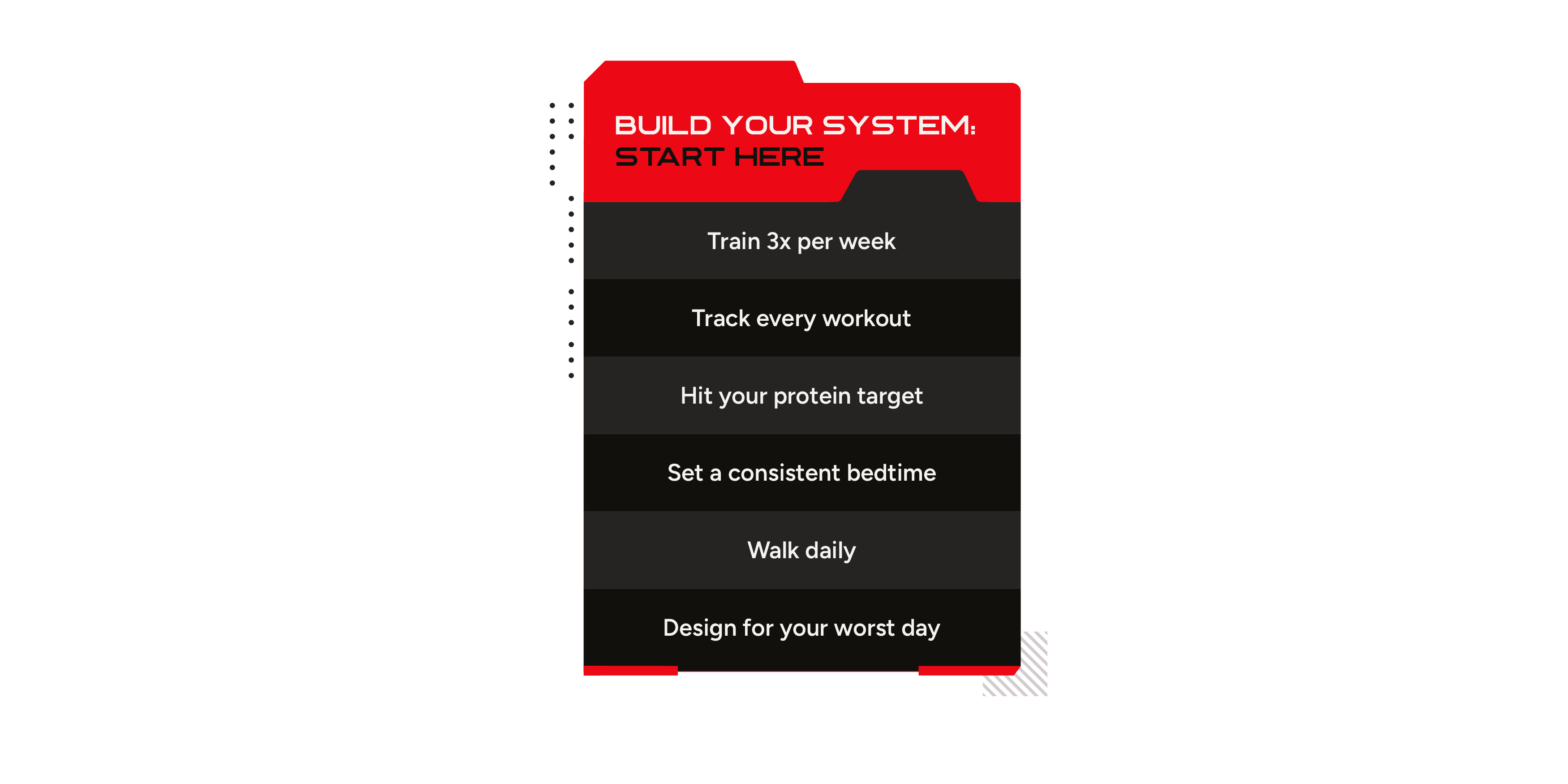
The Bottom Line
Stop looking for the next program.
Stop buying the meal plan.
Stop waiting for the perfect time.
Build a system.
Make it simple enough to survive your hardest weeks.
Stack habits that eventually require no willpower.
Let it run in the background while you focus on your career, your family, and your life.
If you’re not sure how to build that for your situation, that’s where coaching fits in.
Not more information. Application.
A system built around your real life, not someone else’s template.
If you want help putting that together, you can apply for 1:1 coaching here.
I’ve never been out of shape as an adult.
Not because I’m special.
Because I stopped chasing quick fixes and built something that lasts.
The corporate grind didn’t beat me.
Fatherhood didn’t derail me.
The system held.
It’ll hold for you too.
Find more from Coach Sam on…
Instagram: @Samokunola