
What coaching looks like in this day and age
If you’ve been in this industry long enough, you’ve seen it change.
There was a time when hiring a coach meant getting a PDF, a calorie number, maybe a weekly email check-in, and that was considered high touch.
Information wasn’t as accessible. Research wasn’t as widely discussed. Most people were figuring things out through trial and error.
That’s not the world we live in anymore.
Today, we have decades of hypertrophy research clarifying mechanical tension, proximity to failure, lengthened-position training, and volume landmarks. We understand energy balance, protein requirements, fatigue accumulation, and periodization far better than we did even ten years ago.
We also have apps that auto-adjust loads, track weekly weight averages, and analyze adherence trends in real time.
So if tools are better and information is everywhere, what exactly is a coach for now?
Not more information.
Integration.
Modern coaching is the alignment of physiology, psychology, and structure. It’s not about knowing more than everyone else. It’s about applying what we know consistently and intelligently over time.
Results still matter
Let’s be clear about something.
Coaching exists to create results.
Fat loss still requires a sustained energy deficit.
Muscle growth still requires mechanical tension, sufficient volume, proximity to failure, and adequate recovery.
Progress still requires structured overload and fatigue management.
Those principles haven’t changed.
A coach today should understand MEV, MAV, MRV. They should understand how to manage fatigue across mesocycles. They should understand stimulus-to-fatigue ratios and how to structure phases.
But here’s what experience teaches you quickly:
Knowing the science rarely solves the real problem.
Execution does.
And execution is where things get messy.
Where coaching actually happens
Most people don’t fail because they lack knowledge.
They fail because they’re human.
They panic when the scale jumps up two pounds from water retention.
They struggle to push close to failure because discomfort feels threatening.
They interpret one off-plan meal as “I blew it.”
They want to cut calories aggressively instead of trusting a slow trend.
They let a stressful week turn into abandoning the phase.
I’ve seen this hundreds of times.
You can give someone the most optimally structured mesocycle in the world. If they don’t trust the process, or don’t know how to interpret what’s happening, they’ll sabotage it.
Hypertrophy is mechanical.
Adherence is psychological.
Modern coaching means understanding both.
It means knowing when to adjust calories, and when to explain glycogen fluctuations. It means knowing when fatigue is physiological, and when it’s stress from outside the gym. It means teaching clients how to think, not just what to do.
Why systems matter
At RP, this is why systems matter so much.
Defined volume landmarks.
Structured mesocycles.
Clear progression models.
Objective tracking.
Not because we like rigidity.
Because structure reduces noise.
When someone understands how their program works, they stop reacting emotionally to every data point. When they understand why a deload exists, they stop feeling like it’s a step backward. When they see predictable progression week to week, they stop chasing novelty.
Systems create stability.
And stability creates consistency.
Technology changed the game. But it didn’t replace the coach
There’s a narrative that apps and AI are going to eliminate coaching.
I don’t see that happening. What I see is technology raising the standard.
Apps can calculate load progressions more precisely than most people can manually. They can track rolling weight averages. They can spot adherence drift faster than a spreadsheet ever could.
That’s not a threat. That’s leverage.
When technology handles calculations and trend analysis, it frees the coach to focus on interpretation and strategy.
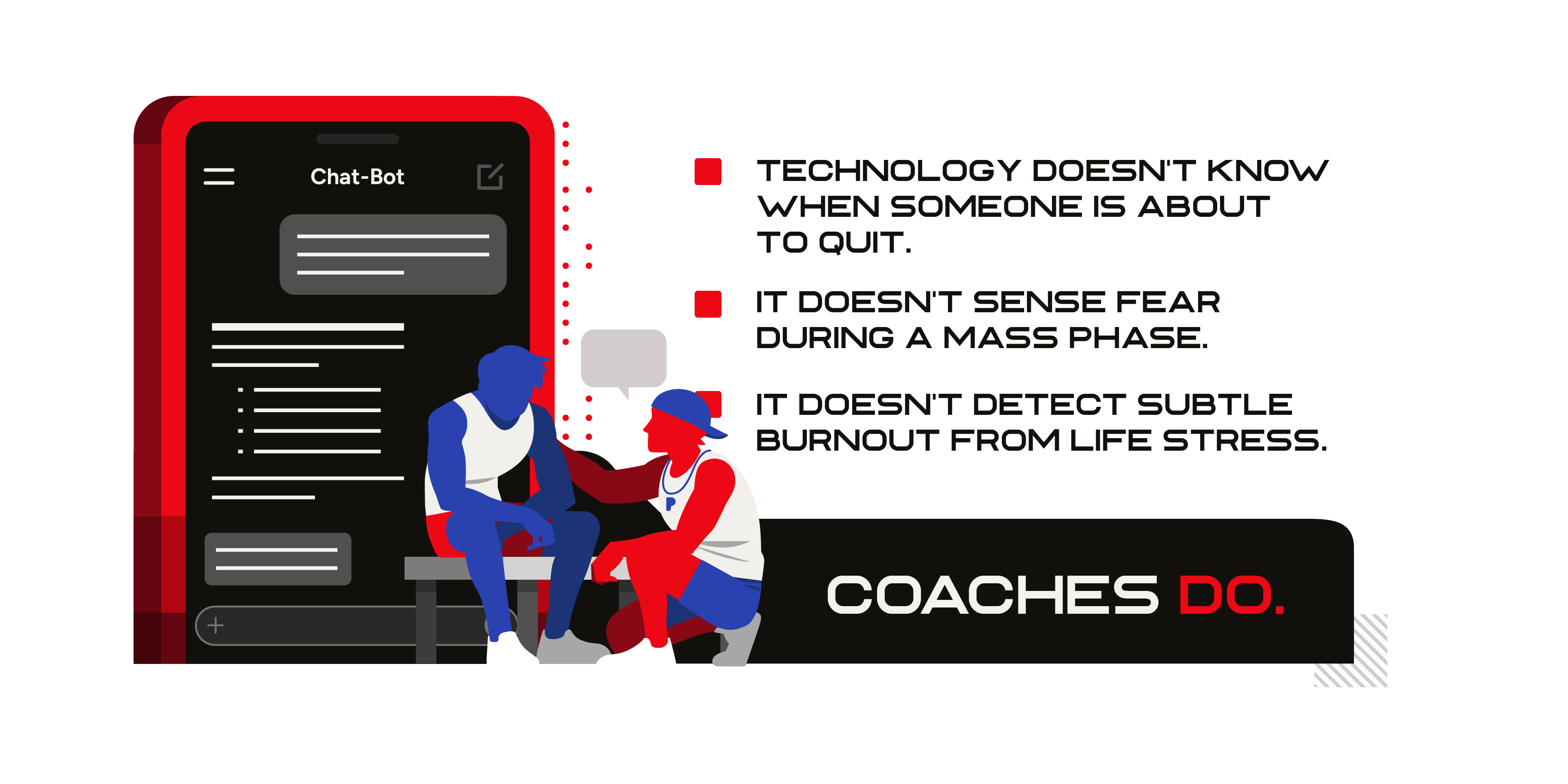
Technology increases precision.
Coaching provides perspective.
And perspective is often what keeps someone in the game long enough to see real change.
Red and green flags in modern coaching
With more visibility and marketing than ever, it’s important to know what to look for.
A green flag in coaching today is clarity. Adjustments are based on trends, not single weigh-ins. Programming follows a logical mesocycle structure. There is a clear explanation for why calories change or why volume increases.
You feel challenged, but not confused.
Over time, you become more competent. You understand what’s happening. You’re not just following orders; you’re learning.
A red flag is reactivity. Slashing calories after one high weigh-in. Adding volume without considering fatigue. Constant novelty without progression. Emotional intensity replacing structured decision-making.
Another red flag is the absence of long-term thinking. If there’s no discussion of phase transitions, no fatigue planning, no strategy beyond the next two weeks, that’s not coaching, that’s improvisation.
Motivation is not a system.
Without systems, progress doesn’t compound.
The standard now
What coaching looks like today is not just smarter programming.
It’s alignment.
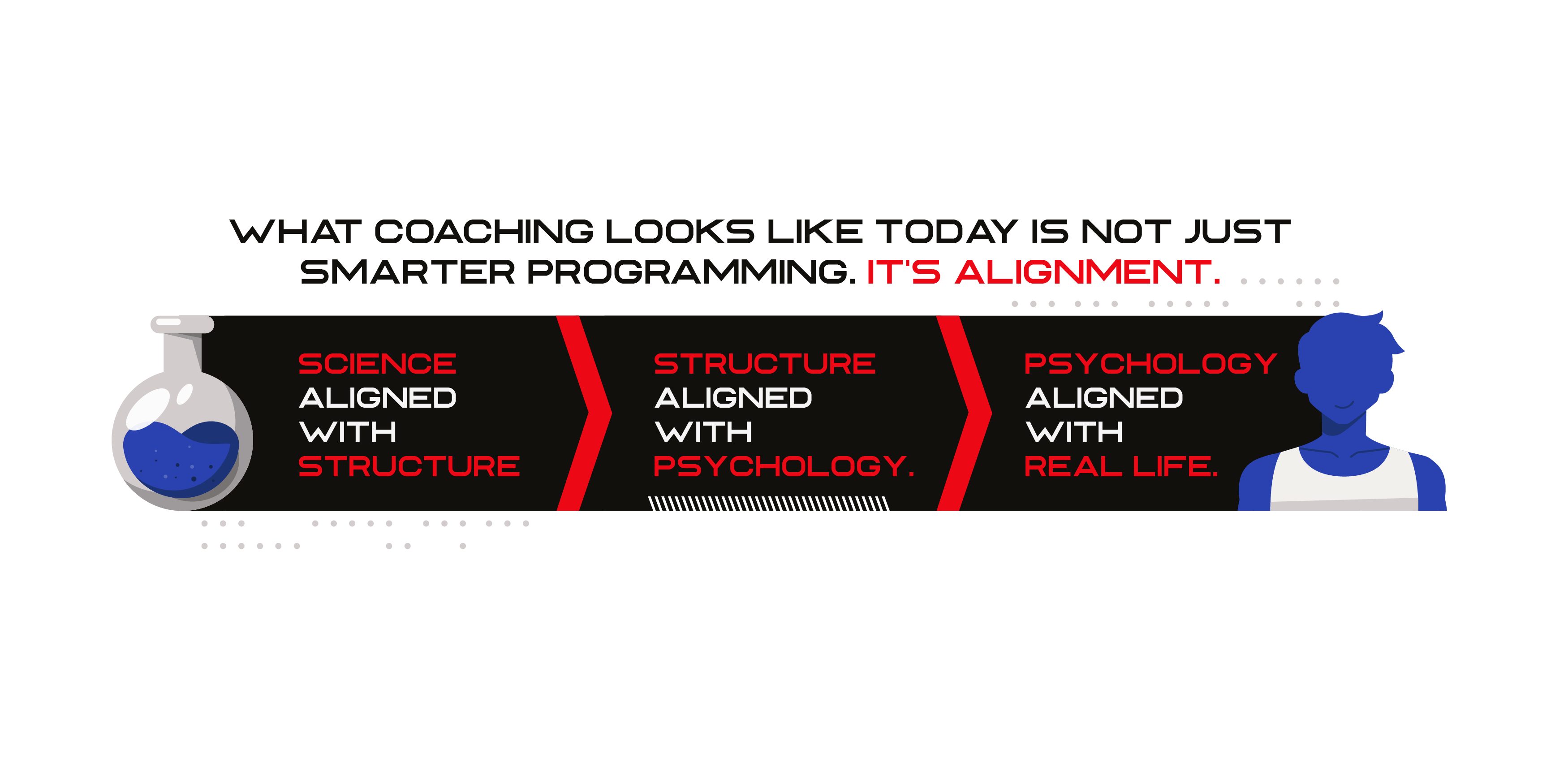
At RP, we’ve always emphasized systems. Clear volume landmarks. Structured mesocycles. Objective tracking. Data-informed adjustments. Strategic deloads. Long-term planning.
Not because complexity is impressive.
Because clarity is powerful.
When someone understands how the system works, they stop chasing hacks. They stop panicking over normal fluctuations. They stop reinventing their approach every month.
They build momentum.
And momentum, sustained over years, is what builds impressive physiques.
The coach of today isn’t just someone who writes programs.
They’re someone who understands adaptation, understands behavior, and knows how to bridge the two.
In an age overflowing with information, the value isn’t more content.
It’s clear systems.
And the ability to guide someone through the friction that inevitably comes with meaningful change.
If you’re trying to connect the dots between training, nutrition, and real life, that’s exactly where coaching fits in. It’s not about more information. It’s about having someone help you apply it in a way that actually works for you.
If you’re ready to stop guessing and start building momentum, you can learn more about coaching here.
Find more from Jorge on…
Instagram: @jorge_bfitness